Natural gas is ‘normally’
(conventionally) produced from
permeable rocks such as
sandstones and limestone from
anticlinal traps some 1 to 3 km
below the earth’s surface.
Unconventional gas comes from
non permeable rocks, often the
hydrocarbon source rocks, and
the hydrocarbons are retained in
these source rocks over very
large areas. Whilst production
from conventional reservoirs is
relatively simple and flow to
surface can occur naturally the
gas from unconventional
reservoirs requires the
combination of horizontal
drilling and fracture
stimulation to enable commercial
quantities of gas to flow to
surface.
Gas production from
‘unconventional’ gas resources
is not new, for example, coal
bed methane is the feedstock for
the 15 to 20 Million tonnes per
annum of LNG projects scheduled
to come on stream in Queensland
over the next 3 to 5 years.
Further, unconventional gas from
shale gas contributed
approximately 15% of the total
gas production in the USA during
2009.
Over recent times, there have
been various reports of activity
in the shale gas industry in the
USA, all pointing to the major
turnaround in the overall
natural gas supply situation in
the USA due to the extremely
large plays (resources) of shale
gas.
Only 5 to 7 years ago, the USA
was forecast to become a net
importer of LNG to supplement
the then dwindling production of
natural gas from conventional
sources. However, just over the
last few years, with the rapid
acceleration achieved in
delineating and developing shale
gas resources, the USA is now
looking at becoming a net
exporter of natural gas with
various companies now seeking to
convert proposed LNG importation
terminals to export LNG
terminals.
Further, the major IOC’s are
paying a lot of money to achieve
a position of future ownership
of the shale gas assets, as
evidenced by recent sales of
shale gas resources.
For example, in early 2011 BHP
agreed to purchase Chesapeake’s
US shale gas assets in one state
(Arkansas), being for a reputed
total volume of 2.4 TCF for a
price of $4.7 billion, and in
2008 BP paid $1.9 billion for
25% of Chesapeake’s
(Fayetteville) shale gas assets
just a month after it bought
Chesapeake’s Woodford shale gas
resources in Oklahoma’s Akhoma
Basin for $1.75 billion.
In 2010, Exxon/ Mobil acquired
XTO Energy Inc, a shale gas
producer for $34.8 billion.
PetroChina is buying 50% of a
prolific shale gas project from
Canada’s Encana Corp for $5.4
billion, marking the largest
Chinese investment yet in a
foreign gas asset. Not too
dissimilar to the
CNOOC/Chesapeake deals, the
PetroChina/Encana tie-up is
another win-win that enables
China to acquire quick exposure
to the shale gas boom in North
America.
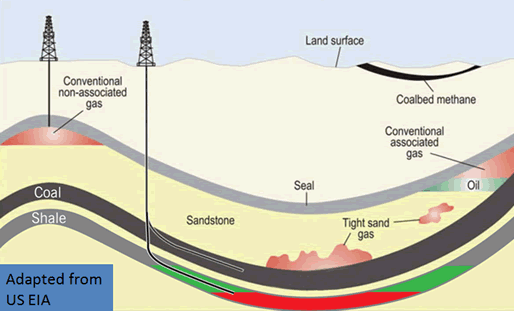
Diagram of Shale Gas
The following schematic,
gives a visual
description to the
various ‘plays’ showing
conventional and
‘unconventional’
hydrocarbon
accumulations.
Figure 1: Schematic of
‘unconventional’ shale
gas accumulations.
|
 |
|
|
|
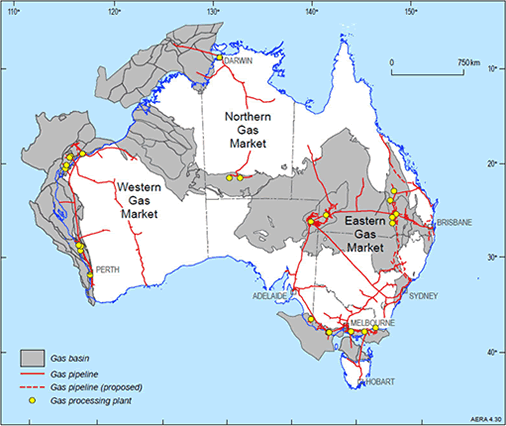
Diagram:
Shows
Australia’s major
sedimentary basins,
domestic gas markets and
pipelines.
|
 |
|
|